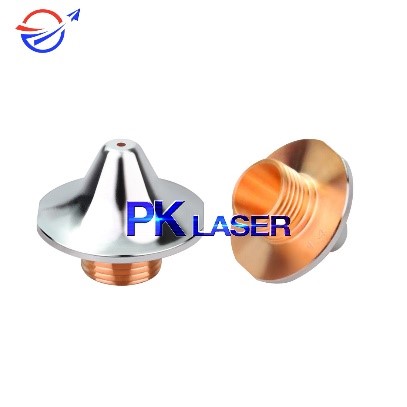
How does nozzle choice affect cut quality?
During laser cutting, energy is absorbed mainly in the thin molten layer at the cut front. Vaporization of heated material, molten slag ejection, heat conduction, and melting all contribute to heat loss. Laser power, process parameters, the optical configuration of the cutting head, and nozzle selection therefore matter to the process.
The source article lists common nozzle diameters of 1.0–1.5 mm for thin sheet, 2.0 mm for medium sheet, and 2.5 mm for thick sheet. It also gives the oxidation reaction Fe + ½ O₂ → FeO.
Choosing nozzle diameter
The article gives the following comparisons for thin and thick sheet:
- Thin sheet, 1.0–1.5 mm nozzle: described as producing a thinner cut face.
- Thin sheet, 2.0 mm nozzle: described as producing a thicker cut face; corners may melt and form burrs.
- Thick sheet, 1.0–1.5 mm nozzle: at higher cutting power, heat-dissipation and cutting times may be longer.
- Thick sheet, 1.5 mm nozzle: the smaller gas-diffusion area may make operation unstable.
- Thick sheet, nozzle above 2.0 mm: the larger gas-diffusion area and slower gas flow are described as helping stabilize cutting.
Single-layer and double-layer nozzles
Carbon steel cut with oxygen commonly uses a double-layer nozzle. The article recommends a single-layer 1.5 mm nozzle for steel up to 2 mm thick, and a double-layer 2.0 mm nozzle for steel 3–12 mm thick.
Stainless steel cut with nitrogen uses a single-layer nozzle. The article recommends a single-layer 1.5 mm nozzle for sheet under 2 mm and a single-layer 2.0 mm nozzle for sheet over 2 mm.
Need help choosing a nozzle?
Send PK LASER a photo or video of the cutting issue and the cutting-head model in use. The technical team can help check the nozzle match.
- Zalo / business: 0394 552 839
- Technical support: 0394 542 839